
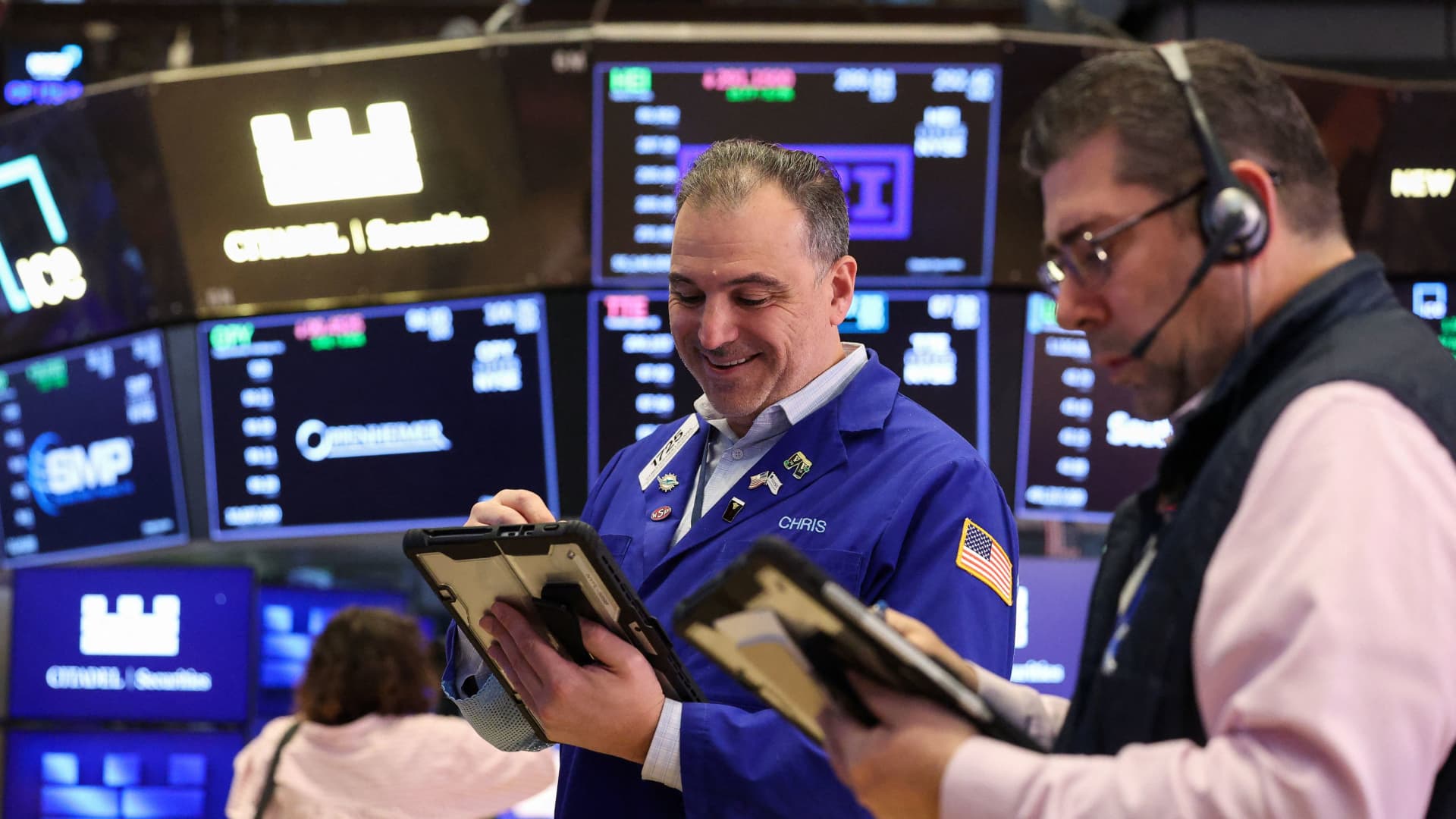
Traders work on the floor at the New York Stock Exchange (NYSE) in New York City, U.S., April 8, 2026.
Brendan McDermid | Reuters
The S&P 500 fell slightly on Friday, but the index managed to post a solid weekly gain as traders kept an eye on the fragile two-week ceasefire between the U.S. and Iran.
The broad market index dropped 0.11% to end at 6,816.89, while the Nasdaq Composite moved higher by 0.35% and closed at 22,902.89, bolstered by gains in key semiconductor stocks such as Nvidia and Broadcom. The Dow Jones Industrial Average declined 269.23 points, or 0.56%, ending at 47,916.57.
Still, the S&P 500 added about 3.6% this week, and the Nasdaq rose about 4.7% in the period. The Dow, meanwhile, gained 3% on the week. The indexes posted their best weekly performances since November.

S&P 500, week-to-date
President Donald Trump on Friday accused Iran of “short term extortion of the World by using International Waterways,” saying in a Truth Social post that its leaders “don’t seem to realize they have no cards” and that “the only reason they are alive today is to negotiate!”
This comes a day after the president warned that Iran should not charge fees to oil tankers that are traveling through the Strait of Hormuz, writing in a post on Truth Social: “They better not be and, if they are, they better stop now!”
Oil prices seesawed as concerns around the strait’s reopening hovered over the market. West Texas Intermediate crude futures ultimately fell 1.33% to settle at $96.57 a barrel, and international benchmark Brent crude futures declined 0.75% to settle at $95.20.
Inflation was top of mind for investors this week as they assessed a number of key reports amid concerns that rising energy prices spurred by the conflict in the Middle East would ripple through the U.S. economy.
March’s consumer price index report showed that inflation was in line with expectations, standing at 0.9% for the month and 3.3% on an annual basis. That incorporated a 10.9% jump in energy costs due to the conflict.
When excluding energy prices, however, the report revealed inflation was tame last month. Core CPI increased just 0.2% for the month and 2.6% compared with a year ago, coming in below expectations. Inflation had been sticky at 3% heading into the Iran war, which has been going on for nearly six weeks.
Nevertheless, the war has still led to a jump in inflation fears. According to a University of Michigan survey released Friday, consumers are anticipating that inflation will jump to 4.8% over the next year. That’s up a full percentage point from March’s reading.
“The Fed will do everything in its power to look past whatever data points it gets for March and April,” said Tim Holland, chief investment officer at Orion. That’s assuming “there is an off-ramp between the U.S., Israel and Iran,” he added.
While Holland does believe the Iran war will “wind down” from here — and that oil prices will reset, by extension — he cautioned that investors should get more concerned about its inflationary impacts if the price of WTI crude is still trading around $100 a barrel by early to mid-June.
“You’ve got this potential toxic cocktail of already depressed consumer sentiment and a real re-rating of inflation expectations higher,” he said. “That’s just that’s going to be a tough spot for the economy and put the Fed in a bit of a pickle.”