
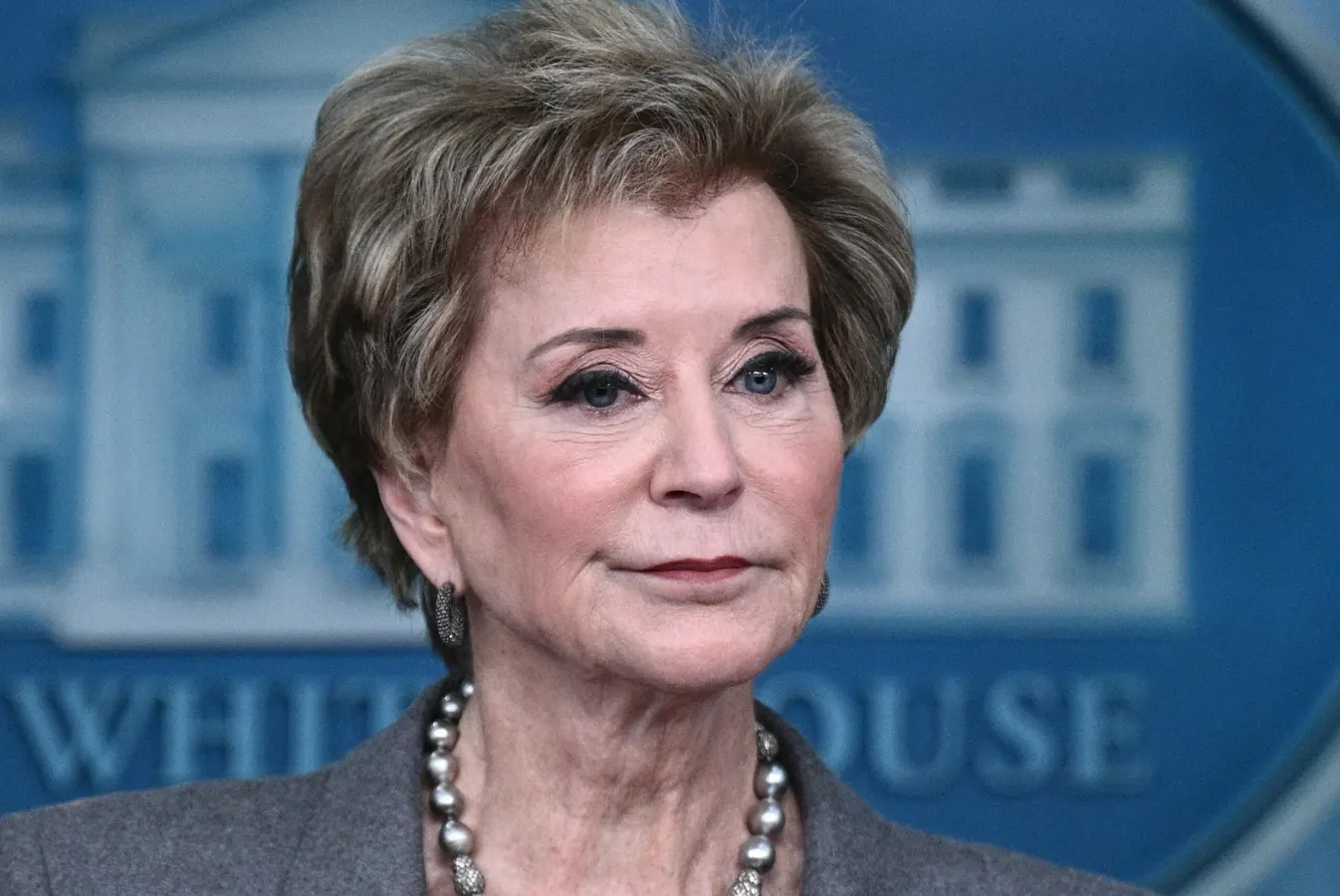

US Secretary of Education Linda McMahon speaks at the White House in Washington, DC, on November 20, 2025. The Education Department began sending out student loan discharge notices to thousands of borrowers covered by the Sweet v. McMahon settlement agreement. (Photo by Brendan SMIALOWSKI / AFP) (Photo by BRENDAN SMIALOWSKI/AFP via Getty Images)
AFP via Getty Images
The Education Department sent out mass student loan discharge notices to thousands of borrowers this week, notifying them that their federal student loans are eligible to be cancelled. The development, which is the latest in the Sweet v. McMahon legal battle, is a win for borrowers, all of whom have been waiting nearly four years for relief.
“SWEET UPDATE: @usedgov has sent relief notice emails to Exhibit C Post-Class Applicants, as required by the settlement,” said the Project on Predatory Student Lending, the legal organization that has been representing borrowers in the Sweet v. McMahon case, in a statement on X on Tuesday. “Every court decision has been clear, the settlement remains in effect — and it requires full relief for Exhibit C Post-Class applicants by March 30, 2027.”
The student loan forgiveness notices were sent to borrowers after the Education Department’s request for an emergency stay of the Sweet v. McMahon settlement was denied by a federal appeals court last week. But relief for borrowers won’t be instant, and some uncertainty remains. Here’s what borrowers should know.
Education Department Lost Appeal To Delay Student Loan Discharges Under Sweet v. McMahon settlement
The Education Department sent out the student loan discharge notices to borrowers pursuant to the Sweet v. McMahon settlement, which the department entered into in 2022 to resolve a long-running class action lawsuit over allegedly stalled or improperly denied Borrower Defense to Repayment claims. The Borrower Defense program offers borrowers a pathway to discharge their federal student loans if they can demonstrate that their school engaged in certain kinds of fraud, misrepresentations, or other misconduct intended to convince prospective students to enroll or remain enrolled in the program. Hundreds of thousands of borrowers sued the Education Department nearly a decade ago claiming that their Borrower Defense applications were subject to unreasonable delays or arbitrary denials.
Under the terms of the Sweet v. McMahon settlement, more than half a million federal student loan borrowers with pending Borrower Defense to Repayment applications who had attended institutions on a court-approved list (called “Exhibit C schools”) were entitled to a discharge of their student loans along with other relief, including refunds of prior payments and corrected credit reporting. A second group of borrowers who submitted Borrower Defense applications in the months immediately preceding final court approval of the settlement are called “post-class applicants” and were entitled to a final decision on their applications earlier this year, more than three years after the Sweet v. McMahon settlement was finalized. If they did not receive a decision from the Education Department, they would be entitled to full settlement relief, including a discharge of their federal student loans.
The Education Department made last-minute efforts to delay Sweet v. McMahon settlement relief for post-class applicants by 18 months, arguing that resource constraints and the massive size of the post-class applicant pool (which exceeds 200,000 borrowers) made it impossible to meet the settlement deadline. But two district court judges rejected the extension request. The department appealed to the Ninth Circuit Court of Appeals, but last week that court denied the department’s request for a stay pending appeal, effectively keeping the settlement obligations in place, including student loan forgiveness.
“The DOE can point to no changed circumstances that render it inequitable to apply the same settlement agreement that it bargained for years ago,” wrote the unanimous Ninth Circuit panel in its decision. “The DOE knew by February 27, 2023, over three years ago, that the Post-Class Applicant group totaled over 205,000 people.”
Student Loan Discharge Notices Go Out To 170,000 Borrowers
Roughly 170,000 borrowers who are considered post-class applicants under the Sweet v. McMahon settlement, and who had attended an Exhibit C school and had not received a formal Education Department decision on their Borrower Defense application, were supposed to receive notices by March 30th that their federal student loans were approved for discharge. Following the Ninth Circuit’s ruling rejecting the department’s request for an extension, borrowers received those notices this week.
“You are receiving this letter pursuant to Paragraph IV.D.2. of the Settlement Agreement reached in the civil action: Sweet v. McMahon, No. 3:19-cv-03674- WHA (N.D. Cal.) (“Agreement”),” reads the standardized notice sent to borrowers on Monday. “You submitted a borrower defense to repayment discharge application after June 22, 2022, and on or before Nov. 15, 2022, for the loans associated with your enrollment” at an Exhibit C institution. “The U.S. Department of Education (ED) is providing you with this notice because, despite its best efforts, ED could not adjudicate your application on or before Jan. 28, 2026.”
Under the terms of the Sweet v. McMahon settlement, post-class applicants are entitled to student loan forgiveness within one year of the date of their notice. They also would be entitled to other settlement relief including a refund of past payments made on those student loans, and a deletion of any credit reporting associated with the loans.
“Unless otherwise authorized by an appropriate court, ED will take or will ensure that the following actions are taken on your behalf within one year: the discharge of your relevant federal student loan(s); a refund for any payments made to ED on your relevant federal student loans, including relevant federal student loan debt that you previously paid off; and the deletion of the credit report tradeline associated with the discharged loan(s),” reads the notice.
What Borrowers Should Know About The Student Loan Discharge Notices
Importantly, the student loan discharge notices sent to borrowers this week only apply to post-class applicants under the Sweet v. McMahon settlement who attended an Exhibit C school. A second group of borrowers, post-class applicants who attended a non-Exhibit C school, are entitled to a decision on their Borrower Defense application by April 15. If they don’t receive a decision, they will be entitled to a similar notice by that date that their federal student loans are approved for discharge.
The Project on Predatory Student Lending encourages any post-class applicant who attended an Exhibit C school who did not receive a student loan discharge notice to contact them. Borrowers who did receive the student loan forgiveness notice should not have to take any further action for their student loans to be discharged, other than ensuring that their address and other contact information is up to date with the Department of Education.
“Other than confirming your address, you do not have to take any further action to receive any discharge” of student loans, says the Education Department letter. “Your servicer will send you more details about any discharge, including which loans have been forgiven. Your relevant federal student loan debt will remain in forbearance and collections will be stopped while any discharge is being effectuated. Your credit report will also be updated to reflect any discharge when it is complete.”
Borrowers should be aware, however, that some uncertainty about Borrower Defense relief remains, as the Education Department’s appeal of its obligations to discharge federal student loans under the Sweet v. McMahon settlement is still pending. The department noted in the student loan discharge notices sent to borrowers that, “the specific timeframe within which ED must process your application is the subject of ongoing litigation before the United States Court of Appeals for the Ninth Circuit.”